What Is Antarctic Krill?
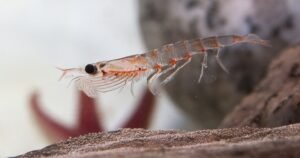
Antarctic krill (Euphausia superba) are small, shrimp-like crustaceans that live in the cold waters of the Southern Ocean surrounding Antarctica. They typically measure around 5–6 centimeters and weigh just 1–2 grams, yet they exist in such enormous numbers that their combined biomass is greater than that of all humans on Earth.
Krill feed on phytoplankton — microscopic plants that grow beneath the sea ice during the Antarctic summer. By eating plankton and being eaten by whales, seals, penguins, and fish, krill form the essential link between the smallest and largest organisms in the Antarctic ecosystem.
Their swarms can be so dense that they’re visible from space, glowing red beneath the ice as millions move together in synchronized waves — a living pulse beneath the frozen surface.
More Info
9 Facts About Antarctic Krill
- Scientific name: Euphausia superba — one of about 85 krill species in the world.
- Size: Up to 6 cm long and around 2 grams in weight, yet form massive swarms across the Southern Ocean.
- Population: Estimated 300–500 million tons of krill live around Antarctica, making them one of the most abundant animal species on Earth.
- Diet: Feed primarily on phytoplankton and algae, using fine comb-like limbs to filter food from the water.
- Lifespan: Usually 5–7 years, depending on water temperature and food availability.
- Habitat: Found mainly under sea ice, which provides both shelter and a feeding ground.
- Predators: Almost every Antarctic animal — including whales, seals, penguins, and fish — relies on krill as their main food source.
- Carbon storage: Krill help fight climate change by consuming carbon-rich plankton and transferring carbon to deep ocean layers through their waste.
- Behavior: At night, krill rise toward the surface to feed, and during the day, they dive deeper to avoid predators — a process called vertical migration.
Why Is Krill So Important to Antarctica’s Ecosystem?
Krill are the foundation of Antarctica’s entire food web. Though tiny, they sustain nearly every major animal species in the Southern Ocean — from penguins and seals to whales and seabirds. Without krill, life in Antarctica would simply collapse.
- Main food source: Krill are the primary diet of whales, seals, penguins, and many fish species. A single blue whale can eat up to 4 tons of krill per day.
- Nutrient recycling: By feeding on phytoplankton and excreting nutrient-rich waste, krill help fertilize the ocean, supporting plankton growth.
- Climate regulation: Krill contribute to the biological carbon pump, locking carbon deep in the sea and reducing greenhouse gases in the atmosphere.
- Indicator of ocean health: Changes in krill populations directly affect other species — making them a key measure of ecosystem stability in the Southern Ocean.
- Essential for biodiversity: Krill swarms create feeding hotspots that attract thousands of animals, shaping the rich wildlife encounters seen on Antarctica cruises.
Where Can You See Krill in Antarctica?
Although krill live beneath the ocean surface, travelers can often witness their presence indirectly, through the abundance of wildlife they attract. The best places to see krill activity are where whales, seals, and penguins gather to feed during the Antarctic summer.
- Antarctic Peninsula: The most productive krill feeding grounds: perfect for spotting humpback whales, minke whales, and penguin colonies.
- Weddell Sea: Known for dense krill populations beneath the pack ice, attracting leopard seals and Adélie penguins.
- South Georgia Island: A hotspot for krill blooms that support massive colonies of king penguins, fur seals, and seabirds.
- Scotia Sea: One of the richest areas in the Southern Ocean, home to large whale feeding grounds.
- Ross Sea: Remote and pristine, this area sustains seasonal krill swarms during the peak summer months.
Wherever there is life in Antarctica, krill are the invisible force behind it all; silently fueling every encounter and ecosystem.
When Is the Krill Season in Antarctica?
The krill season in Antarctica follows the rhythm of light, ice, and plankton growth. During the Antarctic summer (November to March), melting sea ice allows sunlight to reach the ocean surface, triggering massive blooms of phytoplankton: the main food of krill.
As a result, krill populations explode between December and February, forming giant swarms that attract whales, seals, penguins, and seabirds. This is also the best time for travelers to witness the region’s extraordinary wildlife during expedition cruises.
In winter, krill move deeper beneath the ice and survive by feeding on algae attached to the underside of sea ice, waiting for the light to return. This seasonal cycle makes krill the true heartbeat of the Antarctic ecosystem.